


There is no way I can sit and watch my feeder 24/7 or even just during daylight hours. I needed an automated device to record the activity at the feeder. I could have used my video camera from inside the window. With the video camera, I would get a few hours of recording before the media filled to capacity or the batteries were expended. That wasn't going to work. I could purchase the hardware and software to allow my Nikon to capture images in a time lapse fashion. That would be costly.

I remembered seeing on the web somewhere, a programmable time lapse camera that is small, weather proof and under $150.00. I did some research and purchased from Amazon a Brinno TLC 100 and a Fat Gecko Single Suction Cup Camera Mount, all for under $200.00. I ordered both on a Friday and they arrived on Wednesday.
I opened the Brinno package and read the manual. Windows operating system is needed to program the camera. I only own Apple computers. I have always only owned Macs. My children own Macs. Without Windows I was unable to change the application or the time stamp in the camera. I would figure out something later. For the present, I would only use the camera default time intervals and live with the wrong time stamp.

The camera was larger than I thought it would be. From the images I saw online I thought it was 3" tall. I made the above image to give you an idea of the size of the camera. I have large hands. If I stretch out my hand, from the tip of my small finger to the tip of my thumb is close to 10". The actual dimensions of the camera are 3.66" x 7.55" x 2.08".
 Included in the package were four Panasonic AA batteries and a 2GB USB flash drive.

 It was time to choose the time intervals between exposures. I originally chose time setting #2 or five minute intervals. After one day of exposures I removed the flash drive and viewed the video. I caught only two exposures of a squirrel. That meant the squirrel was at the feeder more than five minutes but less than fifteen. That was not enough exposures for me. I changed the intervals to time setting #7 which is factory set at 5 seconds.
 The flash drive is then inserted, the back is locked on and the camera is ready for service.


 The suction cup was then placed on the glass and locked in position. I adjusted the mount so the camera was pointed at the feeder and locked all the adjustable handles and locking rings. I measured the distance from the camera to the feeder and placed the focus dial a the closest setting 20" - macro.

I activated the power and the exposures began.

I remembered seeing on the web somewhere, a programmable time lapse camera that is small, weather proof and under $150.00. I did some research and purchased from Amazon a Brinno TLC 100 and a Fat Gecko Single Suction Cup Camera Mount, all for under $200.00. I ordered both on a Friday and they arrived on Wednesday.
I opened the Brinno package and read the manual. Windows operating system is needed to program the camera. I only own Apple computers. I have always only owned Macs. My children own Macs. Without Windows I was unable to change the application or the time stamp in the camera. I would figure out something later. For the present, I would only use the camera default time intervals and live with the wrong time stamp.

The camera was larger than I thought it would be. From the images I saw online I thought it was 3" tall. I made the above image to give you an idea of the size of the camera. I have large hands. If I stretch out my hand, from the tip of my small finger to the tip of my thumb is close to 10". The actual dimensions of the camera are 3.66" x 7.55" x 2.08".


The back of the TLC 100 has a locking mechanism that closes securely. Once open, the batteries easily slipped into the appropriate holders.


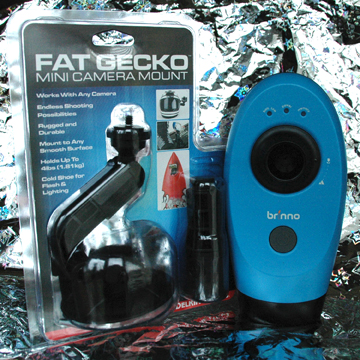
I didn't want the camera on a tripod inside the window for various reasons. I purchased a camera mount with a suction cup to mount the camera outside to my breakfast room window.

The Brinno has a threaded socket to accept a standard 1/4-20 machine screw. The Fat Gecko has a standard 1/4-20 stud to mount the camera.

I was now ready to place the camera outside on the window. I cleaned the window to make the glass as smooth as possible for the best suction.


 |
| View from inside the breakfast room |
©Damyon T. Verbo - all rights reserved


