Saturday, June 16, 2012

Passive Photography - Spectators

An hour was spent outside the grounds of an amateur lawn tennis tournament capturing photographic images. The initial intent was to photograph muscles in action, which can be seen in an earlier post. There was plenty of inaction there, too. A change of mindset was needed.

Players stopped to rest and spectators outside the field of action created opportunities to think differently, a pastoral artistic mode. 


Rest between play 


Spectators with connections to players


Spectators with chance biker


Tell me a story about what you think is going on in each of the above images. 


©Damyon T. Verbo - all rights reserved


Wednesday, June 13, 2012

Action Photography - Muscles

Muscle definition is intriguing. Photographing muscles in action on fit bodies, that's what I'm talking about.


I believe my interest was stirred by viewing photographs of people in motion captured in the late 19th century by Eadweard Muybridge. Muybridge started by photographing a horse in motion to settle a bet as to whether all four hooves of a galloping horse were ever off the ground at the same time. 


He later used the same techniques to photograph people in motion. Muybridge's system of cameras, often numbering 50, is very impressive. His inventions, including a projection system for the series of photographs, led to the refinement of motion pictures.


With these images in my head, I stumbled across an amateur grass court tennis tournament. People with their bodies in motion, flexing their muscles. Here was a chance to capture some muscles in action.


The courts were visible from the road with only an iron fence between the public and the players. I stopped and stayed about an hour. Below are my attempts to capture some muscles in motion. 

One of the situations to overcome was isolating one player.


Figures in the background are distracting

No two players muscles were alike

Each had a different style

The leaner the physique the more pronounced the muscle


Timing. Anticipation.

Most servers left the ground

Of course facial expression is interesting, too.

Not everyone was in motion. I will have spectators next time.

©Damyon T. Verbo - all rights reserved


Sunday, June 10, 2012

Early June in the Square Foot Garden

The first seven days of June have past. Before you know it there will be juicy ripe tomatoes. For now, let's take a look at the square foot garden plus the potato towers.


As of 7 June, over 8oz/226g of young, tender, fresh, sweet snow peas have been harvested. Lettuce will be the next. 


This is the potato tower #1, planted first. Atop the tower is a cherry tomato plant. There are several cherry tomatoes close to harvesting size. Warm nights are needed to ripen the fruit.

The encircled are actually potato plants that grew up instead of out the sides of the tower.

Here are the potatoes that cooperated by growing out the sides of the tower.

This is one of the bell pepper plants. There is one orange and one red plant. 

This is one of the many varieties of full size tomato plants.

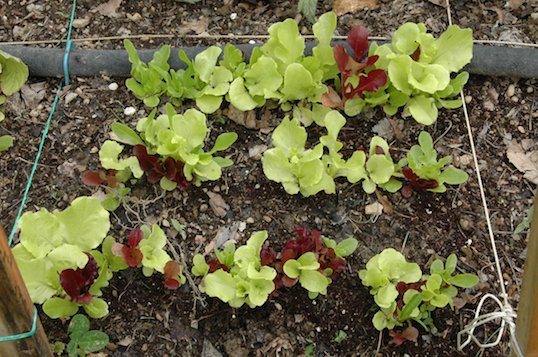
This is the lettuce from a mixed packet of loose leaf style lettuce seeds.

In the center of the plot is a solar powered light that was used to light a few squares when trying to capture time lapse images of slugs at night.


The snow peas will soon be finished bearing fruit. Today melon and cucumber seeds were planted in the rear of the square foot plot now inhabited by the snow peas. This is where the trellis was placed. The melon and cucumbers vines will be trained up the trellis. 


Once the melons begin to form, they will be placed into ladies nylon hose and tied to the trellis. This will provide the melons needed support and still allow room for expansion.


Bush bean seeds were also planted amongst the lettuce squares in the front row of the plot. The lettuce will bolt to seed as the temperatures rise. The beans will take over the squares where the lettuce now grows.


Fertilizer will be added to the squares because of the intense use of the garden. Both fish emulsion and blood meal and green sand will be used. Blood meal and green sand will be scratched into the surface of the soil once the snow peas and lettuce are exhausted. Fish emulsion in a water solution will be applied every two or three weeks. That should be plenty but the plants will be monitored for both under and over fertilization.


Can you almost taste the tomatoes, too?


©Damyon T. Verbo - all rights reserved


Thursday, June 7, 2012

June - Late Spring Flowering

I stopped to photograph some blooms in my garden the first week of June 2012

Flowering Thai Basil a Bonnie Plant purchased at Lowe's
Common Mallow - Malva sylvestris
Hardy Geranium:Wargrave Pink with bee
Brown Eyed Stella Day Lilies
Clematis
Hollyhock
Yellow Loosestrife:Lysimachia punctata'Alexander'
Common Daylily - Henerocallis fulva
Rhododendron

Climbing Rose - Rosa' Zephirine Drouhin' thornless Bourbon

English Lavender 
Hosta
Eastern Purple Coneflower - Echinacea purpurea

I also finished transplanting flowers I purchased at Lowe's.


Red, White and Blue Petunias at the foot of my driveway. Note the soaker hose.
Red, White and Blue Petunias at the foot of my driveway
Planted under the umbrella of a Korean Dogwood - Cornus kousa-planted to memorialize by son, are begonia, impatiens an New Zealand impatiens. Notice the soaker hose in position.


©Damyon T. Verbo - all rights reserved 


Monday, June 4, 2012

Rain And Watering Your Square Foot Garden

One of the important needs of any plant is water. Knowing the amount of water needed is essential. Rain provides some, if not all, water to an outdoor garden. A mix of rain and irrigation will most likely be needed.


It is recommended that each square, in a square foot garden, get 1 gallon/3.785L of water per week. Assuming you get some rain, you need to know the amount of rainfall in volume measured in gallons/liters. Subtract the rainfall from the gallon/3.785L and you have your answer. 


Use a rain gauge or check the weather report for your area to determine the amount of rainfall received. I use Weather Underground. There is actually a weather station within the .5miles/.8K of my house. I assume the rain amount reported at that station is the amount of rain my square foot garden received.


If the rainfall reported is 1.6" for the week, the square foot garden does not need supplemental watering. If not, it will need irrigation.


Let's start with the fact that 1 gallon = 231.00 cu.in. Each square foot needs one gallon of water/week.

  1. One square foot area = 144 sq. in./ 929 sq.cm
  2. 231 cu.in. / 144 sq. in.(1490 cu.cm / 929 sq.cm)= 1.6 in(4cm)
  3. Each square needs 1.6 in(4cm) of rainfall/week.

It is always better to deliver the water to the soil and not by spraying from the top. Watering cans, soaker hoses and drip irrigation are the best methods. Watering cans will eat a good bit of time out of your day. Fill the cans, transport the can to the garden, deliver the water and repeat. Soaker hoses and drip irrigation only need to be turned on, timed and shut off. You will, however, need to calibrate soaker hoses to get the volume of water delivered within a certain period of time. The last and most reliable is a drip irrigation system. 


Drip irrigation uses calibrated emitters. Emitters come in varying sizes, 1/2G/hr, 1G/hr. 2G/hr or 6G/hr.  Just do the math. Turning on the irrigation system for one hour using 1G/hr emitters will supply the proper amount of water needed for one week. Compensate for any rainfall for the week and you will have happy productive plants.


©Damyon T. Verbo - all rights reserved


Friday, June 1, 2012

Treasure Found In My Suburban Backyard

Just two months ago I buried snow pea seeds into my square foot garden plot. Starting last Sunday I found treasure. How much treasure you ask? I will be quantifying the weight of my treasure throughout the growing season. 


I began to weigh and record the treasure Sunday. Each harvest from the garden is weighed and recorded. The weight in grams is entered onto the spread sheet for the total output of my square foot garden (4'/ 1.2m x 4'/ 1.2m) plus the two potato towers and one potted Black Cherry Tomato plant.


As you can see from the chart above, a total of 172g or just a bit over 6oz. of snow peas was picked from the six 1'/ 30.5cm squares planted with snow peas.  That is a mere 3/8ths of my plot. I am wondering why I didn't plant all 16 squares with seeds. Next year.


The going rate for these sweet, crispy babies is around $5/quart, as of 20 May 2012 in Old City Philadelphia according to Robert's Market Report Blog. I harvested about half that amount and this is just the start of the season. Lots more treasure to find in my suburban backyard. More seeds to bury this weekend.


©Damyon T. Verbo - all rights reserved